Healthy weight
What does 'healthy weight' mean?
Children grow and develop at different speeds. One way to check if a child’s weight is healthy is by using something called Body Mass Index (BMI). BMI uses a child’s height, weight, sex and age to work out a number.
This number can then be put onto a chart (similar to the growth charts in a baby’s red book) to see if your child is underweight, a healthy weight, overweight, or very overweight.
You can measure your child’s BMI on the NHS website.
Children are weighed and measured at school in reception and year 6 to work out their BMI. This is part of the National Child Measurement Programme.
You can find out more about BMI and the National Child Measurement Programme on the NHS website.
Why is healthy weight important?
Having a healthy weight is important for many reasons. Being overweight can lead to health problems like type 2 diabetes, high blood pressure, heart disease and more. It can also affect mental health and may lead to anxiety or depression.
Children who are overweight are also more likely to be overweight as adults, which can increase these health risks even more.
It can be hard to talk to your child about weight, but it’s important to try and talk about it openly and kindly. Talking to your child about weight is a guide from the University of Bath which has lots of helpful tips.
Eating well
People can become overweight when they eat more calories (energy) than they use up through exercise and activity.
It’s important for children to have a balanced diet with lots of different types of foods so they get all the nutrients they need to grow and develop.
The Eatwell Guide is a picture that shows how much we should eat from each food group. It’s a helpful starting point when planning your child’s meals.
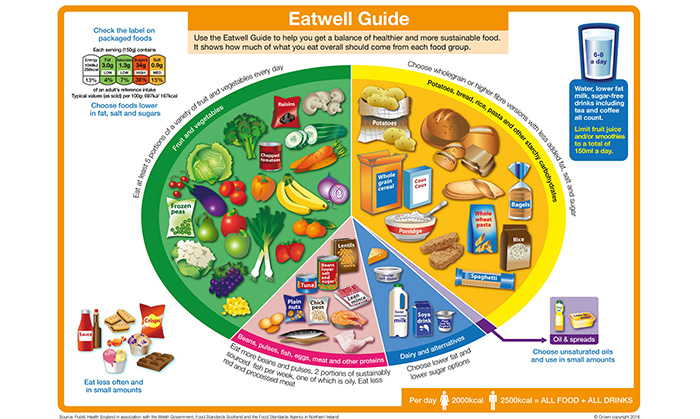
The guide shows a balanced diet divided into five food groups; fruits and vegetables, carbohydrates, dairy, proteins and foods high in fat, salt, and sugar. It visually represents recommended proportions of different food types for healthy eating. Fruits and vegetables are the largest portion, followed by carbohydrates, proteins and then dairy. Foods high in fats are shown as the smallest amount needed.
NHS Food Scanner App
A useful tool is the free NHS Food Scanner app. It helps children learn what is in their food and drink and suggests healthier swaps for items that are high in saturated fat, sugar or salt.
Download the app and follow the instructions on the website: NHS - Healthier Families: Food Scanner app.
Physical activity and exercise
Eating healthy food is important for staying at a healthy weight, but exercise is really important too. Many of us spend a lot of time on screens, which can take time away from being active and playing. Most children should try to get at least one hour of exercise every day.
There are many fun ways for children to exercise, such as walking, running, bike rides, sports, swimming, or dancing.
Children and young people who are disabled should aim for at least 20 minutes of activity each day. This can be split into shorter chunks. They should also try to do strength and balance activities about three times a week.
Walking, cycling or wheeling to school
Walking, cycling or wheeling to school is an easy way to help your child be more active each day. Fresh air and exercise in the morning can help children feel awake, focused and ready to learn.
Many schools have safe places to store bikes and scooters, which helps make active travel a simple choice for families. It is good for your child’s health and helps reduce traffic and pollution near the school gates.
It can also be a special time to talk and listen to your child at the start and end of the day.
If you cannot travel this way for the whole journey, perhaps try parking a little further away and walking the rest. Small changes can make a big difference. Every step counts.
More information can be found on the website RoSPA - Active travel for parents and carers: Encouraging safe and sustainable travel for families.
What services are available in Derby?
- Derby Active runs lots of activities all year round in sports centres and parks across Derby. They also offer a busy holiday programme with plenty of things for children to do - What's on offer for children and families.
- Derby Holiday Activities and Food Programme (HAF) supports families by offering free activities and meals during the school holidays. This helps children socialise, stay active and eat healthy meals when school is not in session - Derby Holiday Activities and Food Programme - Derby City Council
- Live IT is a programme run by the Derby County Community Trust. It is for anyone aged 5 to 17 who is registered with a Derby or Derbyshire doctor and is on the 85th BMI centile or higher. The programme teaches young people about healthy eating and exercise in a fun and supportive environment.
- Cycle Derby encourages more people to ride bikes by offering lessons and providing useful cycling resources.